Friday, March 28, 2008
Training while traveling
This week, I had my first experience maintaining my training while on business travel. Although it took a little more logistical planning, it ended up being successful.
Work brought me to midtown Atlanta from Monday through Thursday this week. On Monday, I completed my morning swim in Birmingham before getting on the road for a noon appointment in Atlanta. I completed my next swim with the Dynamo Masters Wednesday evening. With a variety of swimmers, including a couple with Olympic Trial cuts, the 3600 meter long course practice provided an excellent workout. I returned to Birmingham Thursday night, just in time to get a good nights rest for my normal Friday morning swim.
Since my hotel was right in the middle of downtown, I decided to bring my indoor rollers instead of braving the Atlanta traffic on my bike. I maintained my cycling fitness with two one hour sessions on the rollers.
Finally, I made great use of the hotel treadmill with two run sessions totaling about 10 miles. Although it wasn’t a tough training week for me, it was enough to maintain my fitness while traveling.

Wednesday, March 19, 2008
Proper Rest
The switch from daylight savings reminded me of another crucial part of training: PROPER REST. As a general rule, I try to get at least 7 hours of sleep every night. This means getting to bed before 10:00 pm on nights where I intend to work out in the morning. For reasons I have yet to determine, my body seems to be taking much longer to adjust to the time change than in years past. Since I haven’t been falling to sleep until 11pm to 12am lately, I have been skipping morning workouts and trying to make up for it in the evening.
Rather than trying to work out on 5 or 6 hours of sleep, I feel that it is far more important to get a proper night of sleep and get the most out of one evening workout rather than two-a-day. Medical studies have shown how the body can break down very quickly without proper rest. Since day jobs and emergencies tend to interrupt evening workouts far more than morning workouts, I am looking forward to getting over the time change soon.
Tuesday, March 11, 2008
Training update
Originally, I planned to run the Perseverance 5k this past Saturday. I like to run occasional 5k races as a speed gauge. For the 10k run in Xterra, 5k runs are a useful tool to determine how much speed work I need. Unfortunately, the freezing temperatures and slick roads kept me indoors for the day. Instead of lying around the house, I did find the motivation to get a good two hour “brick” workout in.
For those new to triathlon, a brick workout is basically just a workout that includes at least two tri sports back to back. The idea is to acclimate your body to using the different muscle groups required for different sports back to back. Anyway, my indoor workout on Saturday included 40 minutes on my rollers followed by a 20 minute run at 10mph. I repeated this twice. With daylight savings ending, race season is just around the corner. It’s crucial to stay healthy and consistent with training, despite what mother -nature decides to do.
Monday, March 3, 2008
Final Snake Creek Gap
This past weekend marked the final Snake Creek Gap Time Trial for the year. I went into the final event feeling very strong and confident. The excitement of the final race caused me to start out much faster than usual. Unfortunately, this left my energy reserves depleted before the last 4 miles. The extreme technical difficulty and climbing in last 4 miles of this event will make or break your time. Unfortunately, it broke me this time. I ended up about 3 minutes slower than my fastest time trial on this course. However, considering all of the variables of mountain biking, that is pretty insignificant for a 34 mile mountain bike ride that takes around 3.5 hours. I hoped to take another 5-10 minutes off of my time from the last event. However, it was still a strong showing and I even won my class.
In the end, this event will go a long way to ensuring a successful triathlon season. Since this ride was much more difficult than anything I will encounter during the cycling portion of triathlon races, it will serve as a great mental edge.
Wednesday, February 13, 2008

Tuesday, February 5, 2008
Snake Creek Gap 2
This past weekend, I completed the second of three Snake Creek Gap Time Trial mountain bike races. Compared to my first try last month, this race went really well. In my first try, the 34 mile ride took 4 hours and 3 minutes. This time out, I dropped almost 35 minutes with a final time of 3 hours and 29 minutes! I attribute this huge drop in time to increased familiarity with the course, increased fitness, and new-bike-itis.
One of the biggest difficulties of mountain biking is proper gear selection. Too large of a gear will cause early muscle fatigue and, at worst, coming to a dead stop on a climb. Too low of a gear will cause you to give up valuable time and even sacrifice stability in some cases. Ideally, you want to be in just the right gear to maintain a smooth pedal stroke over the terrain. Course familiarity plays a big part in this equation, in that you can better anticipate proper gear selection and energy requirements for different sections.
Logging more than twice as many cycling miles this year vs. last year, my cycling fitness continues to make large gains. I have been very consistent so far this year with getting on the bike at least 4 times/week.
Finally, I can't let this end without giving some props to the new Gary Fisher Superfly. While a new toy always seems to add a little excitement, this bike actually offered some real advantages over my previous rides. Specifically, the 29” wheels felt much more stable at all speeds and carried my momentum through the rough stuff with greater ease. Most importantly, the carbon frame didn't show any signs of weakness or flex. Unfortunately this led to its one shortcomming. After spending the last few years on full suspension bikes, and with only one week of riding the Superfly, my taint is still recovering from the three and a half hour epic. Despite the larger wheels, it is still a hardtail, and requires a different riding style than the full suspension rigs. However, I'm convinced that for cross country riding, this is one of the fastest rides around.
Wednesday, January 30, 2008
New Ride

Just knocking the dust off my new Gary Fisher Superfly in the backyard. With about 3 hours of ride time, I can't find anything negative to say about the bike. The XL frame fits like a glove. The 29" wheels roll through rough terrain much more smoothly than any of my past 26" wheeled bikes ever did. At just over 24lbs, it's also 3 pounds lighter than my last dual suspension 26" wheeled bike. The engine is the only thing left to improve...
Sunday, January 20, 2008
Sweat Rate
Sweat Rate
As a mid distance swimmer in college, my average races lasted less than two minutes. With races this short, things like sweat rate and nutrition were not nearly as important as they are in endurance sports. I quickly found that out last season competing in triathlons. In the pinnacle race of my season, the Xterra World Championship, I was crippled by a series of cramps during the run. In an effort to make sure this doesn’t become an issue again, I am doing some hydration and nutrition experimenting in training.
One of the easiest tests that you can do as a start to diagnosing cramping issues in endurance events (anything over an hour), is a sweat rate test. This basically involves weighing yourself before and after a one hour race effort without hydrating. I completed one for the first time today on a treadmill at the JCC and here are my results:
Before weight: 179.5 lbs
After weight: 173.5 lbs
Avg HR: 162 bpm
Treadmill Speed: 9.5mph (no fan)
Temp: approx 70 degrees
With a pound of sweat being equivalent to 15.4 ounces, this works out to 92.4 ounces of fluid loss! As I suspected, this is extremely high. According to articles from Runner’s World and active.com, the average person loses between 27.4 and 47.3 ounces/hr. The highest on record was 125 ounces/hr by former Olympic distance runner Alberto Salazar. Most doctors recommend not losing more than 2% of your body weight over the course of an endurance event. In my particular case, I would need to consume approximately 15 ounces/15 min while running.
Since sweat rate changes with different sports, temperatures, humidities, and altitudes, this is only the first of a series that I plan to complete this year. However, I think this is great baseline information for making sure I maximize my potential in the future.
Monday, January 14, 2008
Website
Unfortunately, some critical files were lost and my website will have to be rebuilt. Stay tuned for updates in the comming weeks.
The Swim
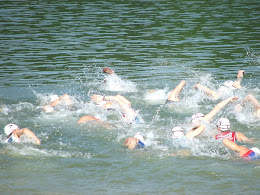
If you look at most elite triathletes, they usually have a strong background in one of the 3 sports. With a finite amount of time to train, this allows extra focus to go towards the weaker sports, while staying very competitive. Luckily for me, I have years of swimming under my belt. This is reflected in the fact that swimming only takes up about 25% of my training. However, this does not mean I don’t have room for improvement. There are two main issues in the swim that I will try and address this year: sighting and start positioning.
Unlike in a pool with lines to follow, open water swimming requires you to constantly pick your head up to sight the course buoy’s, and ensure swimming in a straight line. In my first season, this turned out to be more difficult than I anticipated. As a result, I plan to spend a little more time doing some head up swimming drills, where you pick a point on the pool deck to focus on while swimming freestyle.
One of the exciting things about Xterra triathlons is the mass start. However, after getting caught in swim traffic at a few races last year, I will need to make sure I find a better position to start in. Some of the variables that effect the best position at the start include course set up, tide activity (for ocean races), and number of competitors. After meeting a lot of the pros and learning who the stronger swimmers are, I plan to address this issue by increasing my aggressiveness at the start line to secure a spot next to the stronger swimmers with course experience.
After taking almost 5 years off from my college swimming days before starting back last year, my speed and endurance in the water should continue to improve this year.
Sunday, January 6, 2008
Snake Creek Gap Weekend 1
Well, it’s 5 months away from my first planned triathlon for the year (Xterra Pelham). This means that it’s time to start getting more serious and consistent with my training. My main goals for this year include a top 10 overall finish at Xterra Pelham and a top 3 age group finish at Xterra Nationals. In order to accomplish this, I will need to make improvements in all three triathlon disciplines. To start out, my training will consist of building a strong aerobic base. Compared to later in the season, this basically translates into slower pace and longer sessions, with an additional emphasis on core conditioning.
Over the last month, I have been doing the BBL Saturday morning training rides. These weekly rides are generally around 70 miles in length with approximately 4 hours of saddle time. They provide cycling base training that will be crucial for a successful race season. This weekend, I decided to substitute the BBL road ride with the Snake Creek Gap Time Trial mountain bike race. This is a three race series that I plan to use as a strength builder and fitness indicator.
After yesterday’s race event, I realize that I still have a lot of work to do to get where I need to be. I treated the race as more of a hard training ride than an actual race. This means that I took a couple short rest breaks (less than 5 min) and tried not to spend much time in the red zone (more than 80% max heart rate). With almost 10,000 feet of climbing on the 34 mile mountain bike course, muscle fatigue proved to be a far greater concern than heart rate zones. These are the type of events that put things in perspective and give you that mental and physical edge in Xterra triathlons.
Tuesday, December 4, 2007
Dec 1-2 Training Weekend
This past weekend marked my first serious multisport training since the Xterra World Championship. Xterra Pro Craig Evans called just before the weekend about getting together to train at the Xterra Southeast Championship venue here at Oak Mountain State Park. Although I don't plan to really hit the training hard again until in January, I figured this would be a great opportunity to start the transition to January and pick up some pointers from a veteran.
I ended up getting some great work in. Saturday consisted of one strong 17 mile loop on the mountain bike, followed by a 1 hour trail run that included over 700 ft of climbing. I followed that up Sunday with 2 laps on the mountain bike. The first lap was near Craig's race pace (Note: Craig's race pace=Omar's nose bleed pace). After going hard on the first lap, we backed off on the second, and hit the pavement for the last half back to the start. It was a great weekend of injury free cool fall weather riding.
Sunday, November 11, 2007
Weekend Riding Chattanooga
It's always a blast to ride new trails. This past weekend, seven of my riding buddies and I made the two and a half hour trip to Chattanooga TN for a weekend of mountain biking. We spent Friday and Saturday evening bicycle bar hopping and exploring the Chattanooga waterfront. Saturday was filled with a day of riding the trails at the Ocoee River State Park. The fall colors and colossal valleys provided a breathtaking backdrop to ride. We capped off the weekend riding Tennessee's newest trails at Raccoon Mountain. I don't remember having so much fun on a bicycle since childhood. The 16 plus miles of smooth rolling single track served up the perfect combination of technical switchbacks and fast roller coaster descents.
Tuesday, November 6, 2007
The only black triathlete?
While competing in Hawaii, I noticed that I appeared to be the only African American competitor. My wife Kira recently wrote an interesting post about it in her blog Brilliant Color.
So, am I the only one?
Saturday, November 3, 2007
Vulcan 10k
Note to self: Respect all races. This was the lesson I learned today after running the Vulcan 10k. With a relatively flat course, cool weather, and no swim/bike beforehand, this should have been a walk in the park for me. However, I failed to realize the effects of an epic race less than a week old, followed by a week of tropical vacation living, and 20 hours of travel ending two nights before the run.
I felt strong for the first 3 miles, easily maintaining a 5:30 mile pace. However, leg and side cramping caused the race to take a drastic turn for the worst after the midway point. Unlike Xterra Worlds in Hawaii, I was able to keep running to the finish, albeit in serious pain. I ended up just over 38 minutes, which is still respectable for a first ever 10k race. However, realizing that there was a minute difference in mile pace between the two race halves, and barely a hint of windedness at the end, I know that was far from my potential. As my last planned race of the season, I'll have plenty of time to sort out the cramping issues.
Thursday, November 1, 2007
Hawaii Part 2


 I woke up two hours before the race feeling strong. In an attempt to stay out of the sun, I warmed up for the run on the treadmill in the air conditioned hotel fitness room. Next, I went for an easy 5 mile road ride on my mountain bike, and finally headed over to the race start to get warmed up in the water. As we all lined up for the start, which is supposed to be a mass run into the water from the beach, many eager racers inched 15 to 20 yards into the surf. Race officials ordered us to move back, however the race gun went off with many racers still fully submerged in the water with a substantial head start. This was somewhat irritating, but something I will definitely keep in mind for the future. The surf was noticeably rougher than the previous days, making it very difficult to sight the boys and shore. The mad dash for the first buoy resulted in a huge bottleneck of flailing arms and legs. Unfortunately I got caught in the crowd; however I was able to put the power down after the first buoy and get in a better position for the second lap. Coming out of the water, I was well positioned at #3 in my age group and thirty fourth overall.
After a smooth transition, I grabbed my bike and began the most difficult part of the race. The pain started about 1 mile into the bike. Approximately 3/4 of the 19 mile mountain bike course was climbing. After spending the summer getting much stronger on my local trails and roads, I had a lot of confidence going into the bike. Most of that confidence was humbled on the first in a series of grueling climbs. While this race is notorious for a section called “heartbreak hill”, they all seemed pretty heartbreaking to me. The extreme climbing started the first of what would be some serious cramping issues later on in the race. Normally, some muscle recovery can be found on the descents. However, the descents were so steep, loose, and littered with sharp volcanic rock, that it took most of my strength just to keep my bike upright. My Gary Fisher Hi-Fi gave me plenty of confidence on the descents, as evidenced by my constant jockeying for position between the climbs and descents. Fortunately, I made it through the bike without any crashes or mechanical mishaps.
After racking my bike, I quickly headed off for the run. I started off feeling strong, even gaining position. However, after about 800 yards from transition, I developed a small side stitch. Within the first mile, this turned into crippling chest and abdominal cramps, slowing me down to a walk and finally a complete stop. Although I contemplated dropping out of the race a few times, the thought of traveling over 4000 miles for a race and not finishing was enough to keep me going. The cramping never went away during the run, but the intensity wavered based on exertion. Although I was able to finish, I was forced to walk and jog for the majority of the run.
With the goal of a top 5 age group finish coming into this race, I was disappointed with my 16th place finish. However, since this was my first triathlon season, and by far the hardest race that I have ever done, it served as an amazing learning experience both mentally and physically. Due to the large number of variables, there is a lot of mystery surrounding cramping. I feel as though my prerace nutrition and hydration needs were well met. However, my initial theory is that the cramping issues were more related to a failure to replicate extended periods (more than 2 hours)of race level exertion in training, and improper nutrition during the race. I plan on consulting with a doctor on these issues in the coming weeks. On the plus side, I feel that with more experience and training under my belt, combined with my speed, natural talent, and determination, I can compete on the same level as the best in the world.
Hawaii Part 1
 The trip to Maui started out well. After arriving Wednesday evening and taking two nights to get used to the 5 hour time difference, I felt in top form. Luckily I was able to get a room at the Mau Prince Hotel (the host venue for the race). I originally planned on swimming Wednesday evening to loosen up after a full day of travel. However after talking to the valet, who happened to be a recreational swimmer, I decided that the risk of encountering a tax collector in the dark beach waters was too great. Waiting until Thursday morning, I went for a 20 minute ocean swim on the race course, followed by an easy loop around the 4 mile practice course set up for the bike (no pre-riding of the mountain bike course allowed), and an easy 15 minute run. The choppy waters, extremely hilly terrain, and a noticeable lack of shade, summed up my initial impressions of the course.
After repeating the previous day’s routine in the morning, I went on a sightseeing tour of the Road to Hana. This is an infamous 37 miles of road with more twists, turns and elevation change than I have ever seen. My wife, Kira, started out driving with me riding shotgun. However after a few miles it became clear that I was going to either get car sick or go crazy, so I took the wheel for the rest of the journey. Beautiful mountain top ocean views, waterfalls, black sand beaches, caves, and roadside banana bread and breadfruit combined to make this trip worth the journey.
I spent Saturday relaxing, hydrating, and putting the final touches on our costumes for the post race Halloween Party. We went to Maui Tacos in Kehei, so I could chow down on a prerace Burrito (favorite prerace food). It turns out that I wasn’t the only Xterra racer that enjoys a good Burrito. I met age grouper Rife Hilgartner and pro Ryan Ignatz from Colorado. They gave me the tip to run slime filled inner tubes to combat the huge thorns that line parts of the race course. This turned out to be great advice. I ended up racing passed a number of competitors suffering from flats on race day.
Sunday, October 21, 2007
Basic Dieting & Training Theory
On my way out for an easy road ride today, I ran into the father of one of my neighbors. The decision to start getting in shape for triathlons early in the year coincides with the last time he saw me. He remarked that I looked a lot slimmer than the last time he saw me and inquired about my training and diet. I told him that the weight loss is kind of threefold.
For starters, I currently weigh 175 pounds. This is equivalent to my freshman year of college swimming weight. The weight came off over the course of a few months, but it's a noticeable difference from my 200 pound starting point. At the start, I was lifting weights 3 times per week, averaging about 4 hours of cardio per week split between swimming and mountain biking, and proudly carrying my clean plate club dining card.
I elaborated on my basic training schedule in an earlier Blog, but I'm about 3 times more active than previously. I also eliminated weight lifting from my routine. My weight room time is generally limited to stretching and core exercises. I find that for me, the negative effects of extra muscle mass on my swimming body positioning cancels out the strength gains found from weight lifting. Also, with little serious running or cycling training under my belt, and a finite amount of training time, actual cycling and running is more beneficial. Anyway, the elimination of weights from my routine combined with the sharp incresase in cardio, accounts for the majority of my weight loss.
I love to eat, so I don't get too carried away on the diet. However I do have some basic guidelines. First, I turned in my clean plate club card. I now try and eat until I feel the first signs of being full, rather than until all the food is consumed. Second, I replaced all soft drinks with water. Third, I eliminated beer and limit wine and spirits to about one/week on average. Fourth, I limit the sweets/pastries/doughnuts to special occasions (birthdays,graduations, and weddings). Fifth, I avoid deep fried foods. This is probablly the most difficult (those fries and nacho chips are always tempting), but there is almost always a tastey alternatve. Finally, sitting out on wing nights, avoiding the cheese sauce and multiple meat topping pizzas, and replacing the vending machine chips and candy bars with dried fruits and granola bars, are all daily healthy choices that go a long way without sacrificing too many of the enjoyable parts of life.
Tuesday, October 16, 2007
Beyond Clothing
I came across a pretty neat contest sponsored by Beyond Clothing. Check it out here:
http://forums.mtbr.com/showthread.php?t=339980
Sunday, October 14, 2007
Xterra Worlds Training Update
Two weeks from today I'll be duking it out with the worlds best at the Xterra World Championship in Maui. I'm really happy with my overall training for this season. In my first year of training for triathlons, I've completed three major goals: staying true to a consistent training regiment,showing measureable improvements in all three disciplines, and staying realtively injury free. There was a bike crash in mid July, and some shin splints from running early in the season, but nothing that kept me away from any one sport for more than a few days. The ability speed injury recovery by replacing one sport with another is a great benifit of triathlon training. In my first year, I still have lots of room for improvement in all disciplines. My basic schedule for the last 3 months has been the following:
AM - PM
Mon: Swim
Tue: Run- Road Bike
Wed: Swim- Mnt Bike
Thur: Run- Road Bike
Fri: Swim-
Sat: Swim/Road Bike
Sun: Mnt Bike/Run
This schedule has worked to give anywhere from 12 to 15 hours a week of solid training. I have varied the running between treadmill,track, trail, and road in order to minimize joint impact and try and maximize leg conditioning. I've also mixed in some spin classes with the road cycling in order to minimize my exposure to cell phone wielding motorists. With two weeks to go, I plan to taper with the basic formula of scaling back the amount of time spent doing each discipline, and then scaling back the intensity. More to come on the road to Maui...
Subscribe to:
Posts (Atom)