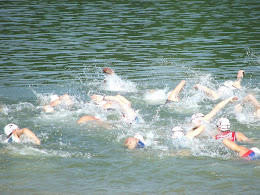
I woke up two hours before the race feeling strong. In an attempt to stay out of the sun, I warmed up for the run on the treadmill in the air conditioned hotel fitness room. Next, I went for an easy 5 mile road ride on my mountain bike, and finally headed over to the race start to get warmed up in the water. As we all lined up for the start, which is supposed to be a mass run into the water from the beach, many eager racers inched 15 to 20 yards into the surf. Race officials ordered us to move back, however the race gun went off with many racers still fully submerged in the water with a substantial head start. This was somewhat irritating, but something I will definitely keep in mind for the future. The surf was noticeably rougher than the previous days, making it very difficult to sight the boys and shore. The mad dash for the first buoy resulted in a huge bottleneck of flailing arms and legs. Unfortunately I got caught in the crowd; however I was able to put the power down after the first buoy and get in a better position for the second lap. Coming out of the water, I was well positioned at #3 in my age group and thirty fourth overall.
After a smooth transition, I grabbed my bike and began the most difficult part of the race. The pain started about 1 mile into the bike. Approximately 3/4 of the 19 mile mountain bike course was climbing. After spending the summer getting much stronger on my local trails and roads, I had a lot of confidence going into the bike. Most of that confidence was humbled on the first in a series of grueling climbs. While this race is notorious for a section called “heartbreak hill”, they all seemed pretty heartbreaking to me. The extreme climbing started the first of what would be some serious cramping issues later on in the race. Normally, some muscle recovery can be found on the descents. However, the descents were so steep, loose, and littered with sharp volcanic rock, that it took most of my strength just to keep my bike upright. My Gary Fisher Hi-Fi gave me plenty of confidence on the descents, as evidenced by my constant jockeying for position between the climbs and descents. Fortunately, I made it through the bike without any crashes or mechanical mishaps.
After racking my bike, I quickly headed off for the run. I started off feeling strong, even gaining position. However, after about 800 yards from transition, I developed a small side stitch. Within the first mile, this turned into crippling chest and abdominal cramps, slowing me down to a walk and finally a complete stop. Although I contemplated dropping out of the race a few times, the thought of traveling over 4000 miles for a race and not finishing was enough to keep me going. The cramping never went away during the run, but the intensity wavered based on exertion. Although I was able to finish, I was forced to walk and jog for the majority of the run.
With the goal of a top 5 age group finish coming into this race, I was disappointed with my 16th place finish. However, since this was my first triathlon season, and by far the hardest race that I have ever done, it served as an amazing learning experience both mentally and physically. Due to the large number of variables, there is a lot of mystery surrounding cramping. I feel as though my prerace nutrition and hydration needs were well met. However, my initial theory is that the cramping issues were more related to a failure to replicate extended periods (more than 2 hours)of race level exertion in training, and improper nutrition during the race. I plan on consulting with a doctor on these issues in the coming weeks. On the plus side, I feel that with more experience and training under my belt, combined with my speed, natural talent, and determination, I can compete on the same level as the best in the world.


 I woke up two hours before the race feeling strong. In an attempt to stay out of the sun, I warmed up for the run on the treadmill in the air conditioned hotel fitness room. Next, I went for an easy 5 mile road ride on my mountain bike, and finally headed over to the race start to get warmed up in the water. As we all lined up for the start, which is supposed to be a mass run into the water from the beach, many eager racers inched 15 to 20 yards into the surf. Race officials ordered us to move back, however the race gun went off with many racers still fully submerged in the water with a substantial head start. This was somewhat irritating, but something I will definitely keep in mind for the future. The surf was noticeably rougher than the previous days, making it very difficult to sight the boys and shore. The mad dash for the first buoy resulted in a huge bottleneck of flailing arms and legs. Unfortunately I got caught in the crowd; however I was able to put the power down after the first buoy and get in a better position for the second lap. Coming out of the water, I was well positioned at #3 in my age group and thirty fourth overall.
After a smooth transition, I grabbed my bike and began the most difficult part of the race. The pain started about 1 mile into the bike. Approximately 3/4 of the 19 mile mountain bike course was climbing. After spending the summer getting much stronger on my local trails and roads, I had a lot of confidence going into the bike. Most of that confidence was humbled on the first in a series of grueling climbs. While this race is notorious for a section called “heartbreak hill”, they all seemed pretty heartbreaking to me. The extreme climbing started the first of what would be some serious cramping issues later on in the race. Normally, some muscle recovery can be found on the descents. However, the descents were so steep, loose, and littered with sharp volcanic rock, that it took most of my strength just to keep my bike upright. My Gary Fisher Hi-Fi gave me plenty of confidence on the descents, as evidenced by my constant jockeying for position between the climbs and descents. Fortunately, I made it through the bike without any crashes or mechanical mishaps.
After racking my bike, I quickly headed off for the run. I started off feeling strong, even gaining position. However, after about 800 yards from transition, I developed a small side stitch. Within the first mile, this turned into crippling chest and abdominal cramps, slowing me down to a walk and finally a complete stop. Although I contemplated dropping out of the race a few times, the thought of traveling over 4000 miles for a race and not finishing was enough to keep me going. The cramping never went away during the run, but the intensity wavered based on exertion. Although I was able to finish, I was forced to walk and jog for the majority of the run.
With the goal of a top 5 age group finish coming into this race, I was disappointed with my 16th place finish. However, since this was my first triathlon season, and by far the hardest race that I have ever done, it served as an amazing learning experience both mentally and physically. Due to the large number of variables, there is a lot of mystery surrounding cramping. I feel as though my prerace nutrition and hydration needs were well met. However, my initial theory is that the cramping issues were more related to a failure to replicate extended periods (more than 2 hours)of race level exertion in training, and improper nutrition during the race. I plan on consulting with a doctor on these issues in the coming weeks. On the plus side, I feel that with more experience and training under my belt, combined with my speed, natural talent, and determination, I can compete on the same level as the best in the world.
I woke up two hours before the race feeling strong. In an attempt to stay out of the sun, I warmed up for the run on the treadmill in the air conditioned hotel fitness room. Next, I went for an easy 5 mile road ride on my mountain bike, and finally headed over to the race start to get warmed up in the water. As we all lined up for the start, which is supposed to be a mass run into the water from the beach, many eager racers inched 15 to 20 yards into the surf. Race officials ordered us to move back, however the race gun went off with many racers still fully submerged in the water with a substantial head start. This was somewhat irritating, but something I will definitely keep in mind for the future. The surf was noticeably rougher than the previous days, making it very difficult to sight the boys and shore. The mad dash for the first buoy resulted in a huge bottleneck of flailing arms and legs. Unfortunately I got caught in the crowd; however I was able to put the power down after the first buoy and get in a better position for the second lap. Coming out of the water, I was well positioned at #3 in my age group and thirty fourth overall.
After a smooth transition, I grabbed my bike and began the most difficult part of the race. The pain started about 1 mile into the bike. Approximately 3/4 of the 19 mile mountain bike course was climbing. After spending the summer getting much stronger on my local trails and roads, I had a lot of confidence going into the bike. Most of that confidence was humbled on the first in a series of grueling climbs. While this race is notorious for a section called “heartbreak hill”, they all seemed pretty heartbreaking to me. The extreme climbing started the first of what would be some serious cramping issues later on in the race. Normally, some muscle recovery can be found on the descents. However, the descents were so steep, loose, and littered with sharp volcanic rock, that it took most of my strength just to keep my bike upright. My Gary Fisher Hi-Fi gave me plenty of confidence on the descents, as evidenced by my constant jockeying for position between the climbs and descents. Fortunately, I made it through the bike without any crashes or mechanical mishaps.
After racking my bike, I quickly headed off for the run. I started off feeling strong, even gaining position. However, after about 800 yards from transition, I developed a small side stitch. Within the first mile, this turned into crippling chest and abdominal cramps, slowing me down to a walk and finally a complete stop. Although I contemplated dropping out of the race a few times, the thought of traveling over 4000 miles for a race and not finishing was enough to keep me going. The cramping never went away during the run, but the intensity wavered based on exertion. Although I was able to finish, I was forced to walk and jog for the majority of the run.
With the goal of a top 5 age group finish coming into this race, I was disappointed with my 16th place finish. However, since this was my first triathlon season, and by far the hardest race that I have ever done, it served as an amazing learning experience both mentally and physically. Due to the large number of variables, there is a lot of mystery surrounding cramping. I feel as though my prerace nutrition and hydration needs were well met. However, my initial theory is that the cramping issues were more related to a failure to replicate extended periods (more than 2 hours)of race level exertion in training, and improper nutrition during the race. I plan on consulting with a doctor on these issues in the coming weeks. On the plus side, I feel that with more experience and training under my belt, combined with my speed, natural talent, and determination, I can compete on the same level as the best in the world.